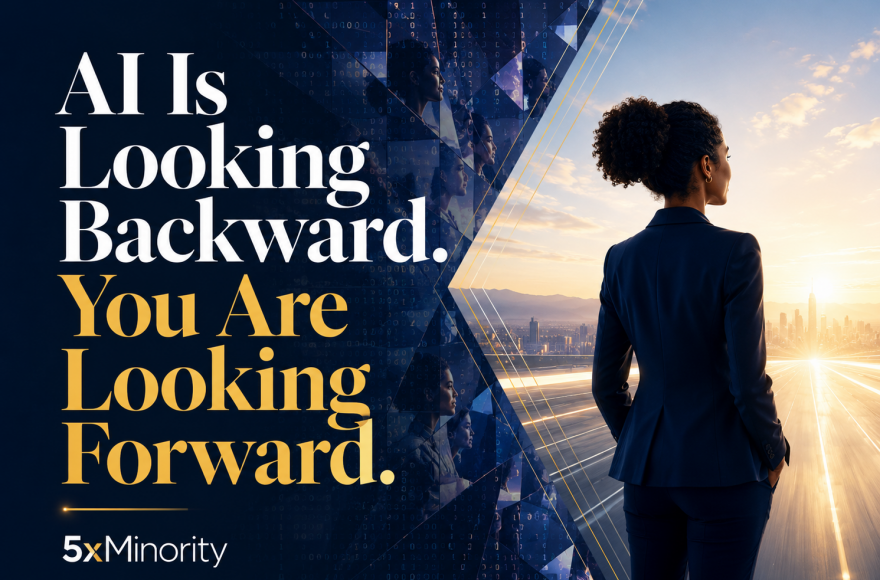
The Sentence I Keep Hearing
There’s a sentence I keep hearing lately, at dinners, on panels, and in private messages from women I admire who are quietly worried about their careers: “AI is going to take everything from us.”
Listen, I get it. Anyone who has worked in technology long enough has seen how quickly work can change. Roles that once were safe changed suddenly, teams shrank, and skills that were once special became the norm. I am not dismissing the disruption. It is real!
But I will say, with conviction, that the claim that “AI is going to take everything from us” reflects an incomplete understanding of what AI actually is. And I want to challenge it. Once we understand what AI is, the fear will not disappear, but it will become something we can work with.
What AI Actually Is (and What It Isn’t)
Data, compute, and prediction
There are three components to the AI we are talking about right now:
- Colossal amounts of data.
- Computational power that a human could not conceive of.
- Large language models are trained to predict what will happen next based on what has already happened.
The datasets comprise trillions of words, images, transactions, posts, and patterns. Everything humans have ever shared or written, published, coded, and recorded. The computing power lets these systems process all of that at scale. The models are mathematical systems that learn from patterns and generate outputs based on them.
I will not be dismissive about this. The technology is amazing. It can distill, draft, evaluate, compare, translate, synthesize, and accelerate. It is already driving work at a pace we are barely keeping up with.
But there is no soul in the system
AI can identify patterns at a scale no human being could match, and we should not dismiss its significance. But power is not the same as wisdom. A system can be trained on vast amounts of language and still have no soul. It has no lived experience, no feeling, no hurt, no memory of being the only woman in the room. It has never had to decide whether to take the leap or stay safe, whether to speak up or protect itself, whether the cost of being visible was worth the possibility of being heard.
It also does not know what it means to spend a lifetime reading the room so carefully that you begin to hope, quietly and almost against hope, that the room might someday learn how to read you back.
What AI offers is extraordinary pattern recognition, built from what already exists. It gives us hindsight at a speed and scale we have never seen before. That is powerful, and it will change how we work, create, and make decisions. But it is not everything. It is not courage. It is not imagination. It is not the hard-earned wisdom that comes from living inside a world that was not always built with you in mind, and choosing, again and again, to help build what comes next.
AI Is a Mirror, Not a Window
AI is often described as a window into the future, but that gives it too much credit. It is more accurate to think of it as a mirror. The models we use are trained on what humanity has already written, built, measured, debated, and decided. They draw from the record of our past, much like a library, an encyclopedia, or an archive. That makes them useful, even remarkable, but it also means they are bound by what already exists.
AI cannot know what we have not yet done. It can describe the world as it has been, and sometimes as it is, but it cannot imagine the world as it should be. It can detect patterns, extend them, and repeat them with astonishing speed, but it does not dream beyond the limits of the data it has been given. It cannot picture a world no one has yet built, because it has never had to long for one.
That is where human creativity begins. It begins in the gap between what exists and what should exist. It begins when someone looks at the patterns of the past and refuses to accept them as the boundaries of the future. AI may reflect our history back to us, but it is still human beings who decide what is worth changing, what is worth building, and what kind of future deserves to be imagined next.
Why Creativity Is Different
Creativity is informed by data, but it is not limited by it. None of us creates from nothing. We create from what we have read, survived, studied, questioned, loved, lost, and learned. We create from the conversations we cannot forget, the meetings that felt off, the systems we have had to navigate, and the quiet moments when we thought, there has to be a better way. That is why creativity is not simply the rearranging of what already exists. It is the human ability to take experience, friction, longing, memory, and imagination, and turn them into something that did not exist before.
That is what AI cannot do. Creativity points forward. It asks the question nobody has asked yet, imagines the product nobody has built, writes the sentence no one has ever written, and walks into a room noticing the silence everyone else has learned to accept. It sees not only what is present, but what is missing. That is the difference. AI is trained on data and pointed at the past. Human creativity is trained by experience and pointed toward the future, and that may be the most important difference of this entire moment.
The Leverage of Being Underrepresented
This means something specific for me as a woman in technology, and it might mean something for you, too.
If the past is the data, then women and people who were underrepresented in the world will be underrepresented in the models. Women’s voices, women of color’s voices, queer voices, immigrant voices, disabled voices, the voices of people who were not invited into the rooms where decisions were made, records were kept, products were designed, and futures were imagined. We were underrepresented in the data because we were underrepresented in the world.
Read that again!
The thing you were taught makes you a minority in tech could now be your competitive advantage. The perspective AI lacks is the one many of us have spent our careers carrying. You know what is not in the training data. You know what was left out. You have an intuition for who is not being seen. You know what it is like to build a career inside systems that were not built for you.
You have absorbed it. And that means you know what to build next.
The Real Risk Is Optimizing the Past
One of the dangers of our current AI moment is that we confuse speed with wisdom. We can now create more code, more content, more decks, more summaries, more emails, and more analysis at a pace that would have seemed impossible only a few years ago.
But faster is not automatically better.
More is not automatically meaningful.
Optimization is not the same as imagination.
If we are not careful, AI will help us replicate the past more efficiently. It will help us reproduce systems that may be broken, biased, or incomplete. It will help us scale what we already have, when what we needed was something we have never had.
Representation is infrastructure
Representation is not a buzzword. It is not a panel topic. It is not a corporate slogan during Black History Month.
Representation is a necessity.
It is a unit of leadership. It is the root of better technology.
The future of technology, and whether it actually reflects the needs of every person inside the system that uses it, depends on who is doing the asking…
Who gets to ask the questions?
Who gets to name the problems?
Who gets to decide what “good” even means?
Who has the power to say, “This is technically correct, and still humanly incomplete.”
Who can ask, who is missing in this data?
That work is not optional and not automatable.
What You Cannot Automate
I am not trying to claim that AI will not change your job. It will. Some parts of my own work have already changed. Some of the repetitive tasks I used to do manually can now be done by a model more quickly, and I am grateful for that. I do not want to spend my life doing work that a machine can do better, faster, and with less friction.
But I refuse to believe that my highest value is the part of me that can be automated. And I do not want you to believe that about yourself either.
Your optimism belongs to you.
Your ability to dream belongs to you.
Your ability to see what is needed belongs to you.
Our ability to build trust belongs to you.
Your ability to read context belongs to you.
Your ability to challenge assumptions belongs to you.
Your ability to create something that has never existed belongs to you.
That was never on the table!
You cannot automate lived experience, moral courage, the wisdom that comes from being underestimated and still rising, nor the future before someone is brave enough to imagine it.
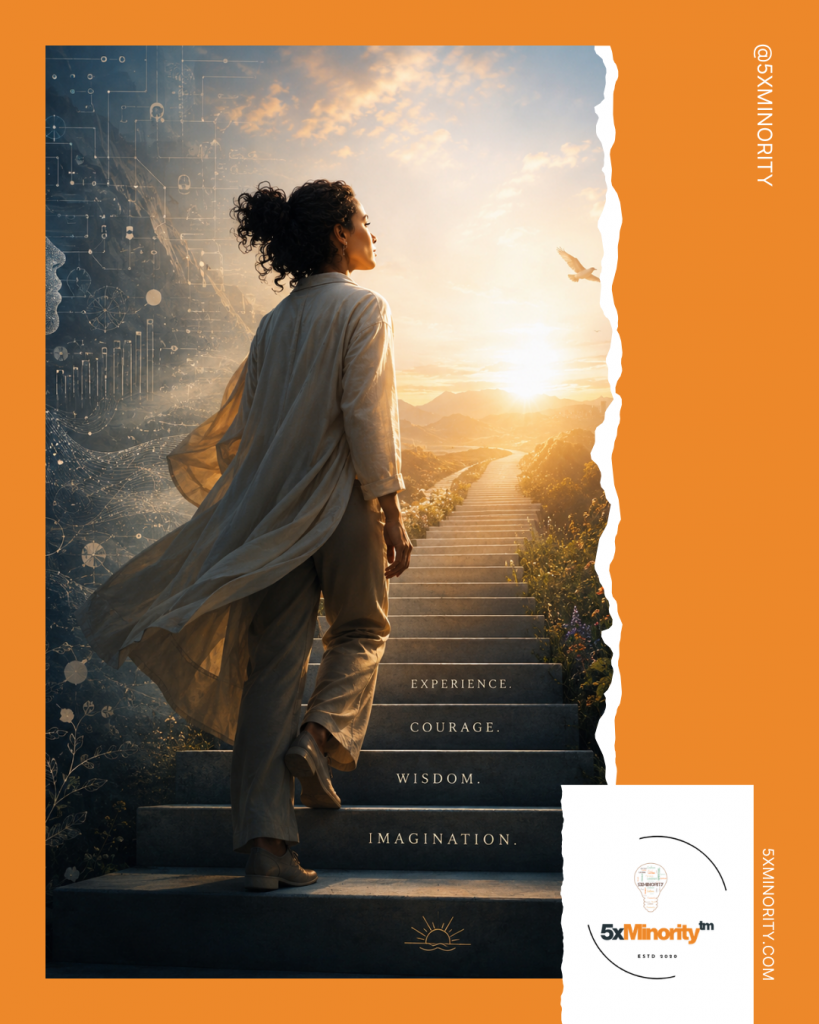
The tools are mirrors, so be smart and use them to save time, to extend your reach, or as a force multiplier. But do not confuse the mirror with the future. The mirror is the model. YOU are the future.
A Better Question
The next time you hear someone whisper that AI is coming for everything, you have permission to ask a quieter, sharper question.
AI will take what, exactly?
Not the part of us that looks forward. AI was never built for that. That part is still ours.
And maybe the better question is not, what will AI take from me?
Maybe the better question is, what can I finally build now that I have more tools, more leverage, and more room to imagine?
There is too much focus right now on what already exists. We need to create what doesn’t exist yet and is needed. So I will leave you with this:
What is something you believe should exist in the world that doesn’t?
That answer is not in any training data.
And the world is waiting for the person who is brave enough to build it.
Note: If this reflection spoke to you, I would love to have you join me on Substack, where I write weekly on leadership, ambition, belonging, and building a life that feels honest.

1 comment